
App Case study

Ayatuk: Quran Verse Reminder
A calm daily verse habit
Ayatuk is a Quran companion I built to stay connected to the Quran on my busiest days. I treated it as a product from the first day: instrumented before launch, shipped a deliberately small MVP around a single habit, then let real engagement data decide what to build next. The launch week alone drew more than 2,000 downloads, and across the iterations that followed, week-4 retention climbed from 1.3% to over 11%.
- 1.3% → 11.4% week-4 retention, early cohorts to recent (Firebase)
- 2,000+ downloads in the MVP launch week
- 120,000+ in-app events tracked last quarter
Product lifecycle
-
Context
I kept bouncing between Islamic apps that felt dated, ad-heavy, and cluttered. None of them helped me do the one thing I actually wanted, which was to stay connected to the Quran on my busiest days.
So I decided to build the app I wished existed: a calm daily-verse habit at its core, with an athan reminder and a qibla compass alongside it.
-
Ownership
I owned Ayatuk end to end: the product decisions, the design, the SwiftUI code, the analytics, the App Store release, and the iteration after launch.
That meant every tradeoff was mine to make and to defend with data: what to cut from the MVP, when to introduce a paid tier, and how to grow engagement without cheapening the experience.
-
Discovery & decisions
Before writing a line of feature code, I set up Firebase Analytics so I could learn from real behaviour instead of guessing.
The first decision was scope. Rather than ship a feature-heavy app, I launched around a single core habit: delivering the number of daily verses you choose. A small surface area let me see clearly where people dropped off and what kept them coming back.
-
Build & ship
I built the MVP in SwiftUI and shipped it to the App Store in February 2026. It drew more than 2,000 downloads in its launch week, which was the signal I needed: there was real demand for a calmer Quran app, and the product was worth pushing further.
With the habit loop in real users hands, the analytics showed me where onboarding lost people and where the experience felt rough, and I tightened both. From there I added in a deliberate order, each step earning the next: a Journey of themed daily verses, a streak system and badges to reward consistency, then athan and qibla once the core habit was sticky.
-
Operate & iterate
This is where the product was really made. I watched engagement continuously and let the data set priorities. Onboarding changes, the Journey, and the streak and badge system each moved the numbers, and together they lifted week-4 retention from 1.3% to 11.4%, comparing early cohorts to recent ones in Firebase. In the latest six-week cohort view the curve also stops decaying after the first week: week 5 holds at 16.7%, higher than week 4. In the last quarter alone the app saw around 475 users and more than 120,000 tracked events, with a clear engagement spike after the most recent update.
I funded it with a premium tier that unlocks a few extras (additional Journeys, verse tafseer, and a home-screen widget for the daily verse) rather than gating the core habit, which stays free. Its job is to support development, not to wall anyone out.
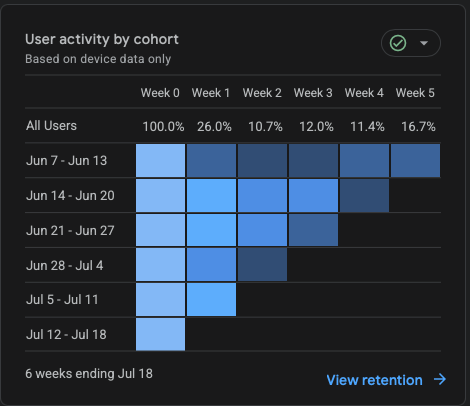
The Firebase cohort view for the six weeks ending Jul 18, 2026. Week-4 retention sits at 11.4% across cohorts, and instead of decaying after the first week the curve flattens and bends back up, with week 5 holding at 16.7%. -
Learnings
Instrumenting before launch was the best decision I made. It turned opinions into evidence and made every later call easier to defend.
Shipping a small MVP and earning each new feature with data kept the app focused and the retention curve moving. And building the business model so that paying is optional, never a wall, kept growth and trust pulling in the same direction.