
Hardware Case study
Portable Vending Machine
From technical drawings to a working prototype
The Portable Vending Machine was my first-year Drawing & Designing project, where I led a team of six from technical drawings to a working prototype. I ran it from a single Figma board that kept our plan, roles, and grading checklist measurable, and I owned the electronics and logic design myself. We won the class demo competition, every team member earned an A+, and the prototype is still on display in the university’s robotics and mechatronics lab.
- Team of 6 led to an A+ for every member
- 1st place winner of the class demo competition
- On display kept in the university robotics and mechatronics lab
Product lifecycle
-
Context
In my first year, the Drawing & Designing class asked us to take an idea from technical drawings all the way to a design and a working proof of concept. We chose a coin-operated portable vending machine.
The constraints were real and specific: build it from recycled materials, keep it within an A3 footprint and under 2 kg, and still make it reliably vend. Delivering the strongest design and a working prototype on a first-year budget meant every choice had to count.
-
Ownership
I led a team of six. Beyond the deliverable, my real aim was to show my teammates how to turn CAD models and paper sketches into something that actually works, and how genuinely fun engineering is once it leaves the page.
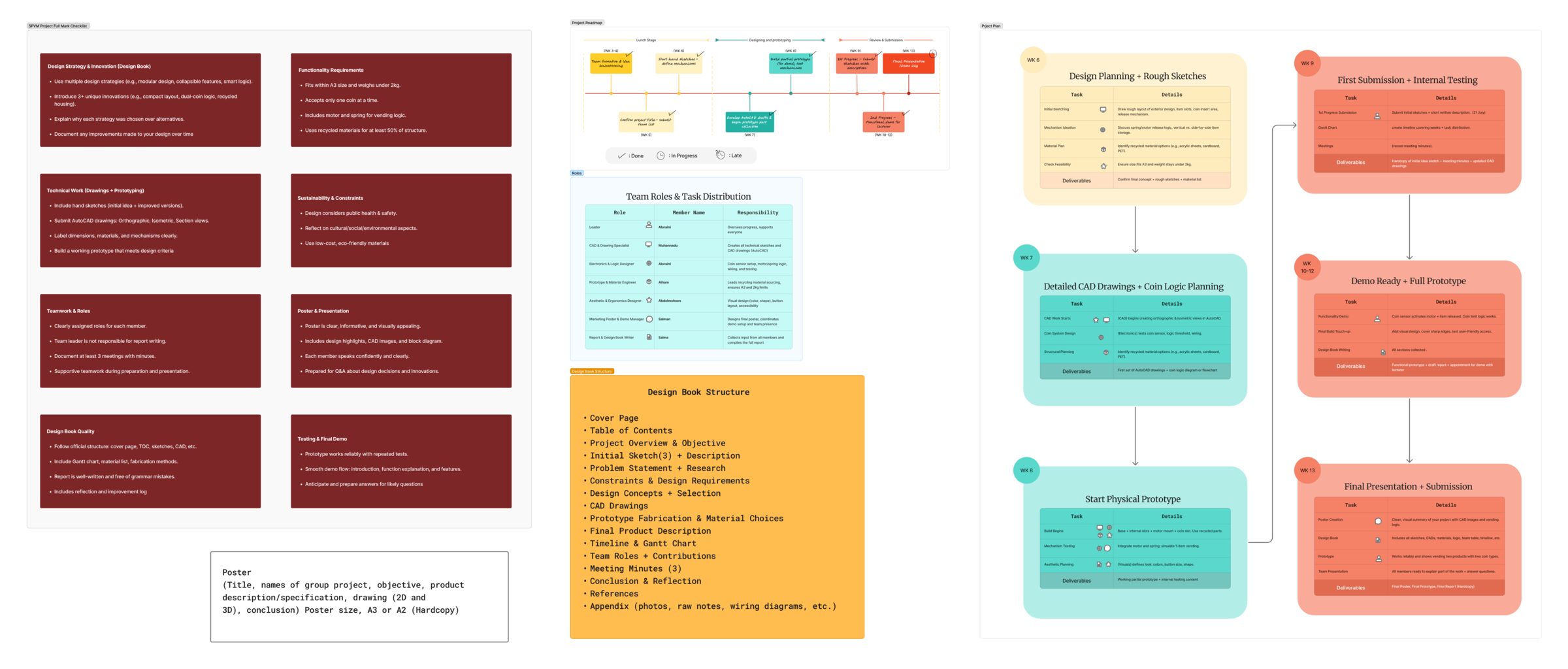
To keep six people aligned, I ran the entire project from a single Figma board: a week-by-week roadmap with a Done, In Progress, or Late status on every task, a defined role for each member, the deliverables for each phase, the structure of our design book, and the grading checklist itself. It kept progress visible and everything measurable, so the team always knew what done and what excellent looked like.
-
Design & decisions
We worked from technical drawings and CAD models, and the early decisions were the ones that mattered: vertical versus side-by-side item storage, a spring or a motor for the release, and which recycled materials (acrylic, cardboard, PET) could hold the build within the A3 and 2 kg limits.
The goal was a design strong enough to defend and a prototype real enough to demonstrate.
-
Build
I owned the electronics and logic. I designed and tested the coin system end to end: the coin sensor, the threshold and coin-limit logic, the motor-and-spring release, and all the wiring. By the demo it reliably vended two different products for two different coin types.
We turned the technical drawings into a functioning prototype, with the mechatronics doing the work the design promised. Getting from sketches to a machine that runs is where most of the learning happened, and where the team saw their drawings become real.
-
Outcome
The result stood out. We won the class demo competition, every member of the team earned an A+, and the prototype is still on display in the university’s robotics and mechatronics lab.
More than the grade, the team finished it having genuinely enjoyed the engineering.
-
Learnings
Leading a team taught me that the deliverable and the people are the same job: the build only came together because everyone understood the goal and wanted to reach it.
And taking something from a drawing to a working object is the clearest proof that a design was right.